 833-294-8583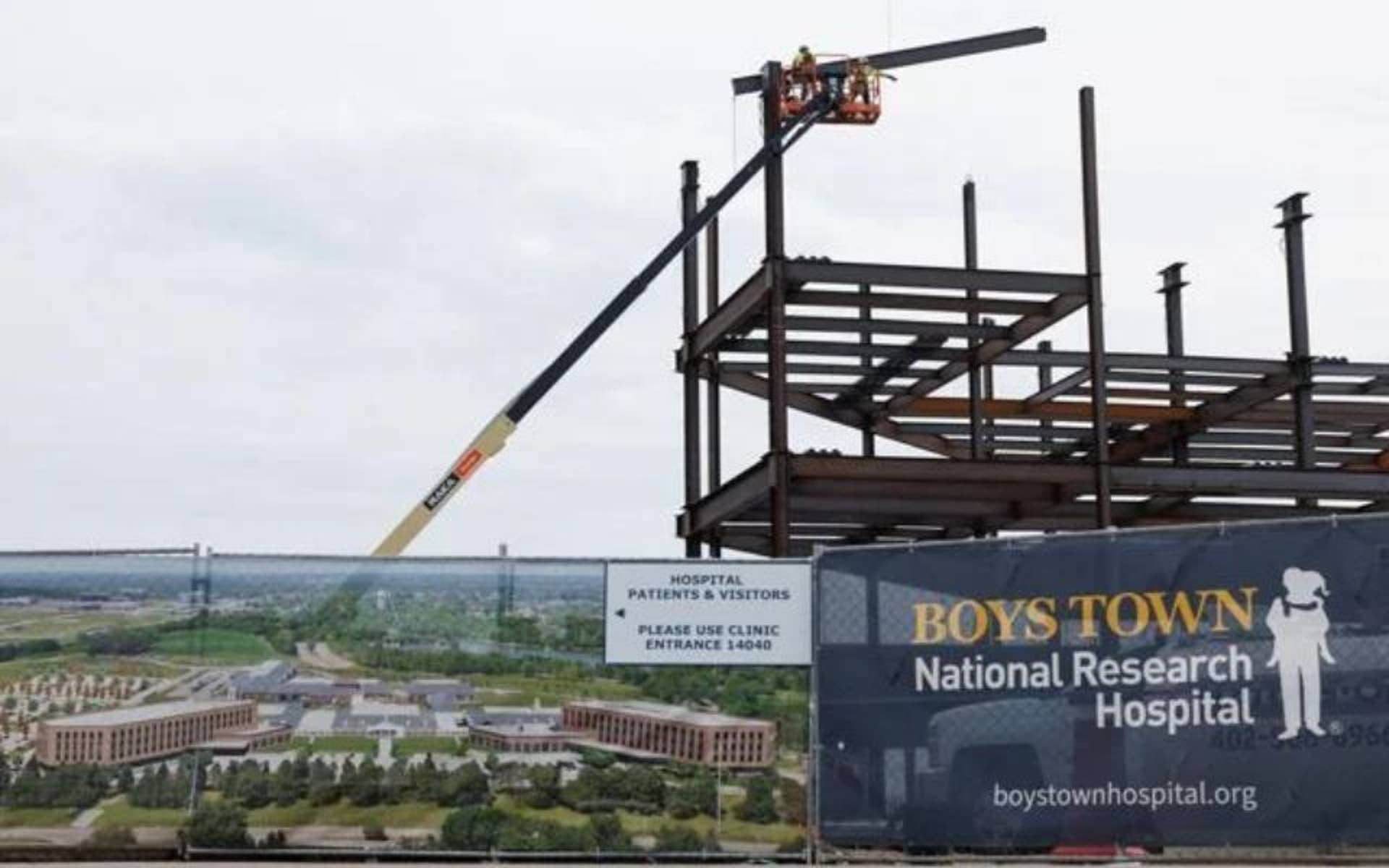
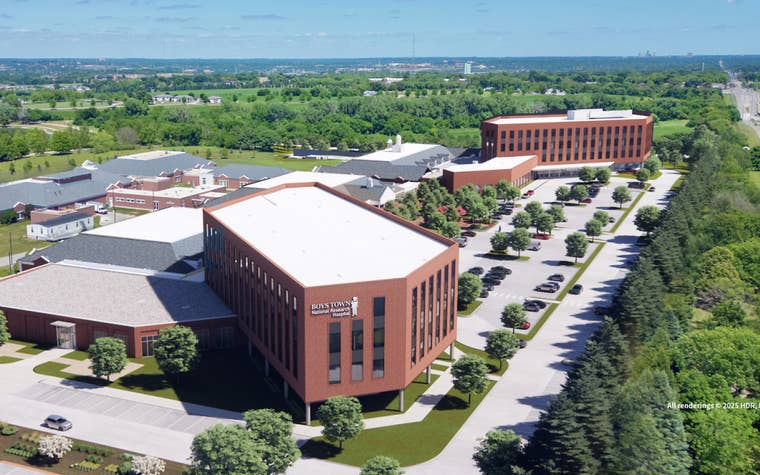
After months of site preparation, steel elements that will eventually rise four stories high are going up on the campus of Boys Town National Research Hospital near 144th and Pacific Streets in Omaha. In the works is a 254,000-square-foot expansion that will take the form of two wings — connected by the existing hospital — set to house clinics and research labs where clinicians and researchers can work together again and additional hospital space that will include 24 inpatient rooms. Rod Kempkes, Boys Town's president and CEO, said the nearly $300 million expansion is slated for completion in November 2027.
The east wing will house expanded hospital-associated clinics, and the west wing will house the Dr. Wayne L. Ryan Clinic and Research Center, named in recognition of a lead gift from the Ryan Foundation. The foundation, which supports medical research, healthcare and education, was established in 1990 by Wayne and Eileen Ryan. Wayne Ryan founded the La Vista biotechnology firm now known as Streck in 1971.
Ryan developed the company's core technology of cell stabilization at a time when blood cells were still being counted manually with microscopes. The first floor of that building will largely house clinics, including those that could be used for clinical trials, with two floors for research and one shell for future expansion, said Dr. Jason Bruce, Boys Town's chief operating officer. The expansion will include a significant investment in an expanded genetics laboratory. As a pediatrician, he was taught in medical school that everyone eventually would have individual genetic therapies.
"That day is here already and expanding rapidly," Bruce said.
Kempkes said the hospital expansion project will topple dominoes beyond the campus' boundaries, namely the relocation of services currently housed at Boys Town's 30th and California location. Boys Town officials, he said, determined that the cost of upgrading the aging building near the former Creighton University Medical Center site would be prohibitive and that it made greater economic sense to build new facilities. Boys Town continued operations at 30th and California after the former CU hospital closed in 2017. That building was later converted to The Atlas Apartments. Boys Town was also running out of space at its west Omaha hospital as patient volumes increased.
Once the expansion project is complete, Kempkes said, researchers housed at 30th and California will move to 144th and Pacific Streets, reuniting with clinicians who have already moved west. The health system follows a translational model that has both types of experts working side-by-side, allowing patients' needs to inform research and the resulting research to be more readily applied to improve patient care.
The 30th and California building is also home to Boys Town's downtown clinic, which currently offers pediatric and adult ear, nose and throat and audiology, pediatric neuroscience services, child and adolescent psychiatry and more. While the clinic will eventually leave the building, it won't leave that part of the city. Kempkes said Boys Town is committed to establishing a new clinic in the vicinity and is close to signing a lease on a new location. "We want to make sure that the community knows we will still serve northeast Omaha," he said.
Boys Town says it also is committed to providing a new home for its preschool for children who are deaf and hard of hearing, a facility that also is currently located at 30th and California. The organization recently broke ground on a new building at 132nd Street and West Dodge Road to house the preschool, believed to be the only one of its kind in the state. Bruce said it draws on Boys Town's expertise in speech language pathology, hearing loss and audiology.
The new location remains within Omaha Public Schools' boundaries, he said, so the preschool will continue to serve OPS students. But the new location will allow the preschool to serve children from other school districts and expand its reach. The building itself, expected to open in spring 2028, will be designed specifically for children with hearing deficits.
"We're really excited for this," Bruce said.
Kempkes said it's not yet known what will become of the building at 30th and California. Boys Town officials hope a developer or future user will purchase it and put it to another use. It has not listed the property for sale, however. That will wait until a new clinic location is determined. The new clinic is expected to open in fall 2027.
"I think the location's going to be very well received," he said.
Gabrielle Merchant, director of the hospital's translational auditory physiology and perception lab, is among the researchers excited for the move west. Trained in clinical audiology in addition to holding a Ph.D. in hearing science from the Harvard-MIT Health Sciences and Technology program, she works closely with the hospital’s clinical audiologists and ear, nose and throat physicians. Some of her research involves taking measurements before or during surgeries when children are having ear tubes placed, which now are done at the west campus, though her lab is housed at the downtown hospital. The audiology clinic on the west campus allows her team to store equipment there. So while they are able to make it work, being together in one location will allow the program to grow.
Diagnosing ear infections is tricky even for experienced pediatricians, she said, and very young children can't reliably tell their doctors whether they can hear well or raise their hand in response to beeps in the traditional way hearing tests are done. So she and her collaborators have been working to develop non-invasive objective measurements to help determine how well kids with infections are hearing, a tool clinicians in audiology now are using in the clinic. They share the results with ENT providers who can use the data to help decide how to treat kids with ear infections.
"It's been really cool to see that sort of reciprocal translational research process happen in real time" she said, where gaps in knowledge are identified in the clinic, investigated in the lab, and the findings translated back to the clinic to improve evidence-based care.
Her team now has created resources that they're sharing with clinics across the country, such as Children's Hospital Colorado and the University of Texas Medical Branch, to implement these tools across the country. Merchant said she knows it sounds cheesy, but seeing tools her team is developing in the lab being implemented in clinics and advancing care for children and their families "is like a dream come true as a scientist."
In addition to adding outpatient rooms, the hospital addition will also include more space for acute care and imaging, as well as a family-friendly space with its first cafe. Kempkes noted that the hospital also worked with the City of Omaha to add an entrance off 144th Street to improve traffic flow and access.