 833-294-8583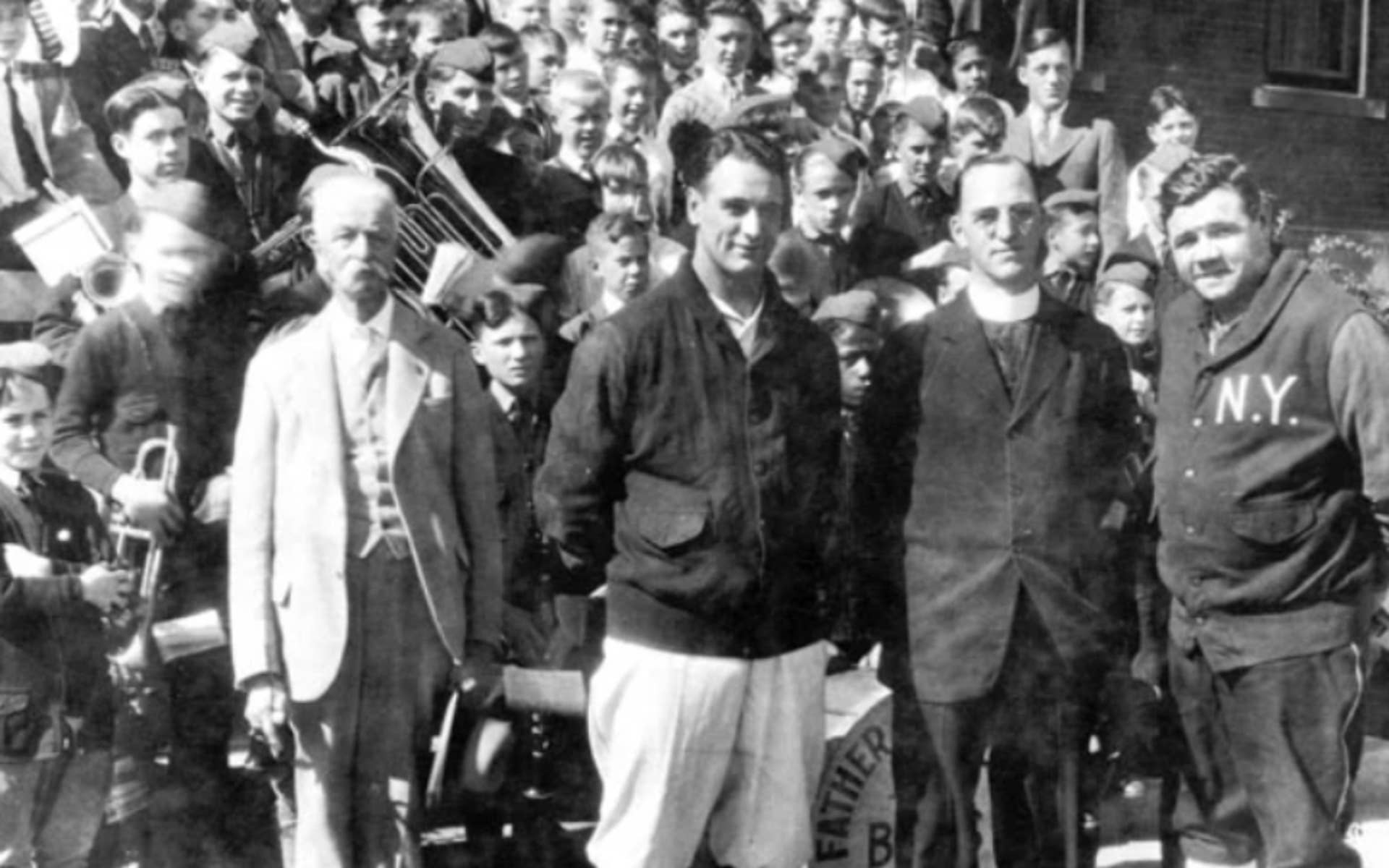
At 1:30 in the morning, a rap on the hotel door woke the (allegedly) sleeping Babe.
The Bambino, George Herman “Babe” Ruth, opened the door that early October 1922 morning at the Hotel Fontenelle to find a World-Herald sportswriter armed with pad and pencil.
Question One: Would Ruth promise to hit home runs in his barnstorming game at League Park on Vinton?
No promises, other than “But I’ll try.”
Question Two: Why did the Yanks drop the World Series? Did the Giants get all the breaks?
After a wide yawn, “There is no alibi. They had the better team.”
In his twin bed, New York Yankees teammate Bob Meusel verified the Babe’s assessment. With a snore.
Before his death in 1948, Babe Ruth came through Omaha four recorded times. The early stops were as an active player picking up off-season money on teams that barnstormed the nation, the last one connected to his affinity for Boys Town from having lived in a Baltimore orphanage.
On that 1922 visit, Ruth and Meusel started their barnstorming tour in Perry, Iowa, on a Friday. They had a Saturday game in Lincoln, and played Sunday in Omaha, drawing close to 4,000 to the ballpark at 15th and Vinton Streets.
Ruth played first base, then pitched the final two innings for the Woodmen of the World company team. Meusel was in left field before taking the mound for the eighth and ninth for the South Side Merchants.
Ruth didn’t hit a home run until a two-run shot in the ninth. Meusel hit one in a fifth-run first inning that carried the Merchants to a 7-5 win.
Ruth’s better-remembered barnstorming game was in 1927, a World-Series championship year, when Lou Gehrig was his travel partner. It also was his introduction to Father Flanagan and Boys Town.
Ruth’s guests at the Oct. 16 game at League Park were the 200 youths living at Father Flanagan’s Boys Home, as Boys Town was first known.
Ruth and Gehrig visited it the morning of the game.
“I want you boys to always think well of this home and to come back and visit it, like I do my old home,’’ Ruth said. “Never forget the work Father Flanagan is doing for you. Father Flanagan is sacrificing his life for you. He is not getting anything out of it, for you boys are gaining all the benefits.
“Don't be ashamed to say you are from Father Flanagan’s Boys’ Home. I have heard a lot about this home, and it is regarded as one of the finest in the country.”
Ruth commended Father Flanagan, the Omaha Bee reported, for leading the national campaign against the exploitation of orphans being adopted solely for manual labor.
Before they made it to the ballpark, Ruth and Gehrig visited the henhouse at the American Milling Company (Amco) at 27th and B Streets.
The attraction? Lady Amco of Norfolk, who minutes earlier laid an egg for a world record’s 171st consecutive day. She had been dubbed Babe Ruth, queen of the non-stop egg layers.
Babe, the player, held Babe, the layer. He left with egg No. 170, secured in a jewel box inscribed “From the Queen of Eggs to the King of Hitters,” which was to be sent to New York.
Babe, the layer, had her streak end at 173 two days later.
At the game, Ruth homered in the fourth and seventh innings and pitched the final three innings (striking out the side with two on in the seventh) of the Brown Parks’ 9-5 victory over Gehrig’s Omaha Printing Co. team in front of 4,500. The pros stepped aside as the local teams, playing for the city champions, went 10 innings before darkness stopped the game at 1-1.
Babe’s shortest record time in Omaha was catching the Rock Island Rocket, going to Colorado Springs, the night of July 3, 1940.
“Name, please,” asked the employee checking in passengers.
“Just call me William.”
A World-Herald reporter had been tipped off that Ruth would be there, traveling to the station by car from Sioux City, Iowa. He peppered the retired slugger with a series of questions from his health to his golf game. His gaiety subsided when Gehrig, in the throes of ALS that would take on the name Lou Gehrig’s disease, was mentioned.
“It was plenty tough on you to leave the game. But worse yet, he doesn’t seem to be getting better.”
Babe’s health was failing from throat cancer in November 1947, when he made his last visit to Omaha as the honored guest of the Boys Town Greater Omaha Round Table. World-Herald columnist Jake Rachman noted Ruth “was noticeably affected when he came into (the) Union Station waiting room, saw and heard the Boys Town band and the crowd.”
He was thinner, a trace of gray, still with the usual brown cap and camel hair overcoat.
At the dinner in the Paxton Hotel, Father Flanagan made the introduction.
“Nobody honors a phony,’’ he said. “Babe Ruth visited Boys Town today and the boys saw in him a friend.
“When I visited Japan last summer, I saw the kids playing in the rubble in the streets, playing baseball. And the name Ruth was a household word, because he taught them to play. Boys want to play.
“The boys cried today at Boys Town and we adults cried a little too. His eye is not as keen, nor his legs as springy as they once were, but his heart is just as big.”
“I give you, Babe Ruth.”
Ruth had barely touched his dinner, World-Herald sportswriter Robert Phipps reported, puffing as usual on a cigar. He received a standing ovation from the assembled 500, spoke briefly — “I was feeling great then,’’ Babe said about his 1927 visit to Boys Town — and under police security returned to his sixth-floor room.
In six months, Father Flanagan was dead of a heart attack while visiting Berlin. Four months later, after one last visit to the Midlands for an appearance at Spencer, Iowa, in June 1948, cancer took Babe Ruth at 53. Boys Town sent a telegram to Ruth’s widow.
“We join with all other Americans in mourning the death of one of our greatest heroes,’’ it began.